September 2026
Made with love
On essentialism, branding and creative direction
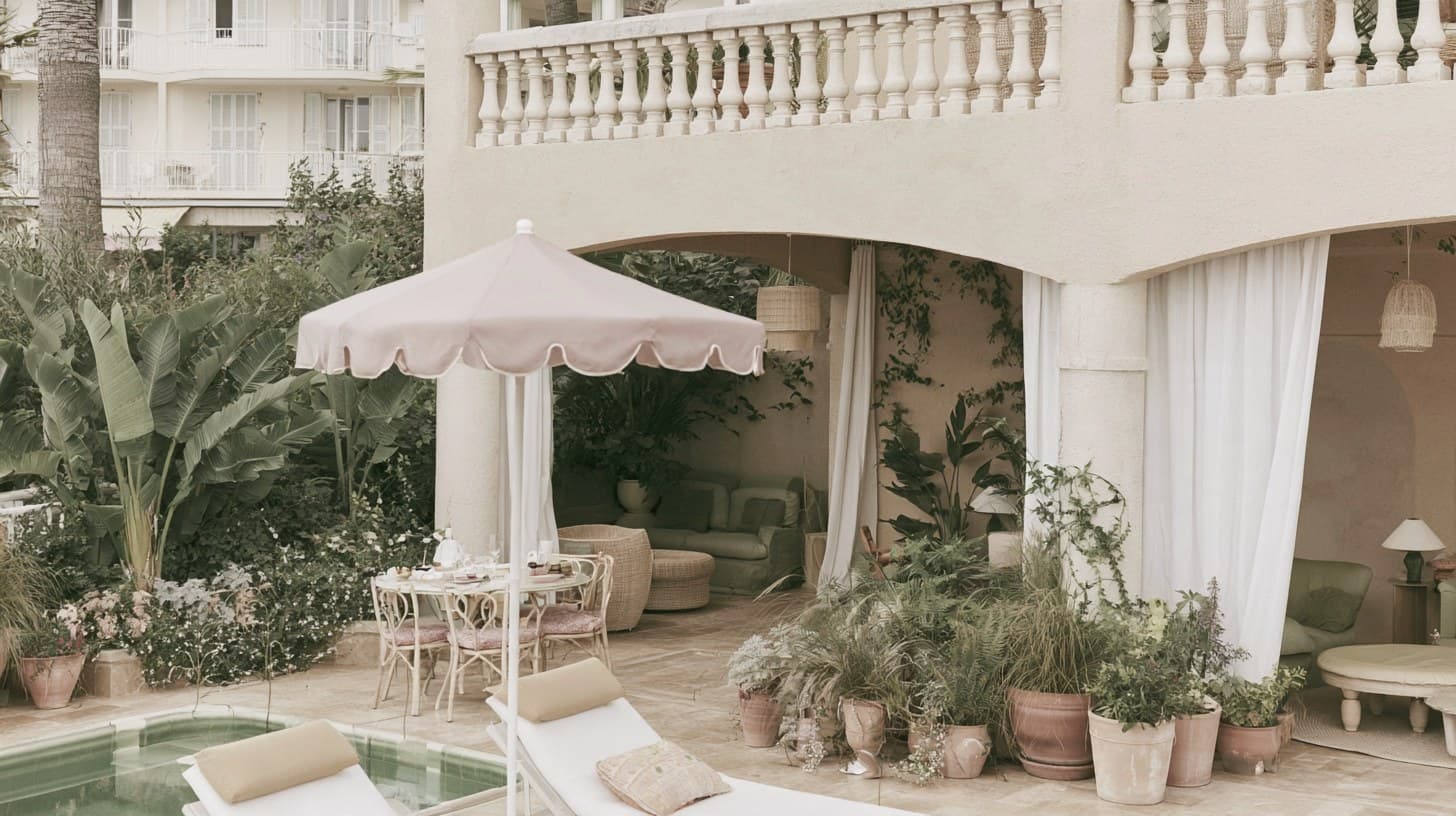
I am writing this from a sunbed at a small hotel on Cap d'Antibes. The pool is just big enough to swim in. It has a bamboo screen behind it and green towels folded on the sunbeds, and from where I lie I can see the back of the older building, a mansion from the 1920s, painted a pale yellow, with dark green shutters and the name of the hotel painted on the wall in an old cursive.
I am reading a book called Essentialism on my iPad. I'm fourteen pages in and already obsessed with the word. Most things I read are one of two things. Either they are pure inspiration, or they are something I can apply to my life and my work. This one is the second. The book is by Greg McKeown, and its subtitle is The Disciplined Pursuit of Less. The principle is simple. Only a few things really matter. Find out which ones they are, give yourself fully to those, and say no to the rest. If it isn't a clear yes, it's a no. Essentialism is about choosing what is essential in your life and letting everything else go.
I picked it up wanting to apply it to my life, as someone with a lot of work to do and a lot going on, and the question the book asks is one I can already feel I'll be asking constantly: with everything I do, am I working from the most important priorities in my life right now? But lying here I can immediately draw a parallel to how we do branding. Essentialism is a word for something we apply in our work a lot of the time. Whatever we do comes down to this. Find the essential. The essential is what the brand represents, and everything else has to give way to it. A product can be many things. The reality of a product is often complex. But the brand is not the product. The brand has to capture a feeling, a memory, an instant connection, something you can remember. And so the brand has to be cut down to the essential.
I look up at the hotel I'm in. There is nothing grand about it, and that is exactly its charm. It is not trying to be something else, and everything it does is aligned with that.
Between the two buildings runs a path of pale stone with white pebbles on either side, and in the pebbles stand lemon trees in pots, an olive tree, a palm, and a tall cactus that leans over everything as if it has been here longer than the hotel. The furniture outside is placed the way you would place it in your own garden. Rattan sofas with white and yellow cushions against a stone wall. Two striped deckchairs. Wooden armchairs with sage green cushions around a low table, on a rug, under a cream parasol, with a red hibiscus in flower beside them. Last night my mother and I sat on those sofas with a bottle of red wine, looking at the stars and the full moon. We took our shoes off. The bottle stood on the floor between us, and we drank the wine from two ceramic coffee cups we had brought down from the room. I couldn't stop thinking about the simple pleasures of life, and how much clutter you have to remove in order to fully feel them.
The hotel has tote bags. On each one it says, made with love. It's not that the phrase is so unique. It's that it represents the exact feeling of this little place. Every part of the building feels carved out with love. It's cute. Every piece of outside furniture is placed for cosy times, slightly adapted to the ones who enjoy a little bit of luxury without the formality that sometimes comes with it. It isn't hard to believe that the hotel, and every decision in making it, has, in fact, been created with love in mind. They have done a great job at it. There is nothing unclear about what the hotel is, or what its charm is. It has chosen. And so, by being here, have we.
As a creative director, this is what I do every time I build a brand. First I find out what the brand should be. I list everything I want it to be. Then I start removing. What isn't it? What did we put on the list because it sounded good? What is only there because someone else has it? Often it comes down to selecting the two or three most important things, so that the brand is clear not only to other people but to you, the one running it, the one who wants to build more of it. Then I align everything to those. Two words, or two values, or two principles, and everything the brand does runs in a red thread from them.
It's about falling in love with everything you are, not everything you aren't. Bring your kings into aces, not your twos into threes. What makes you the most valuable is what deserves your time, and the rest can be handed to people, or brands, who are better at it than you. That is an article of its own, and I'll write it.
This is our favourite strategy for making a brand remarkable. It's easy to understand. It's easy to buy. It's easy to connect to, and it's easy to remember. The mistake, when you create a brand, is to go everywhere and want to be everything. The work is selecting the centre. And the method can be as simple as a phrase. Made with love. How can everything feel like it's made with love? What here does not feel like it, and what do we have to choose away?
That second question matters as much as the first, and McKeown says so too. And on the note of love, a personal one: this book, and this little break with my mother in France, have left me falling in love with the idea of choosing away. Ideas, things, priorities. So that the essential can take the space it deserves.
These are my reflections from Cap d'Antibes, fourteen pages in. They have already left me wanting to do the branding for a hotel like this one. The hard job, of course, is to make a place feel this way. The easy part, for those of us who do branding, is to take a concept already this well put together and bring it into content.
Avec amour, de France,
Isabella
Co-founder, Hiero Studio